Sleep & Cognition
In addition to its well-known role in movement coordination, the cerebellum is also involved in sleep regulation. Moreover, sleep disruption is a common symptom in movement disorders such as Parkinson's disease, ataxia, and dystonia, and contributes significantly to the burden of these diseases. Could the cerebellum be a key target for treating both movement and sleep disturbances simultaneously? Our work with mouse models of ataxia and dystonia has demonstrated that these animals experience sleep deficits similar to humans with these disorders, such as abnormal length of sleep and altered sleep cycles. We also demonstrated that electrical deep brain stimulation (DBS) in the cerebellum could normalize both movement and sleep in our dystonic mouse model. This result is particularly exciting because existing therapies tend to treat motor or non-motor symptoms, but not both. The potential to reduce both motor and non-motor symptoms with a single treatment highlights the importance of the cerebellum in health and disease.
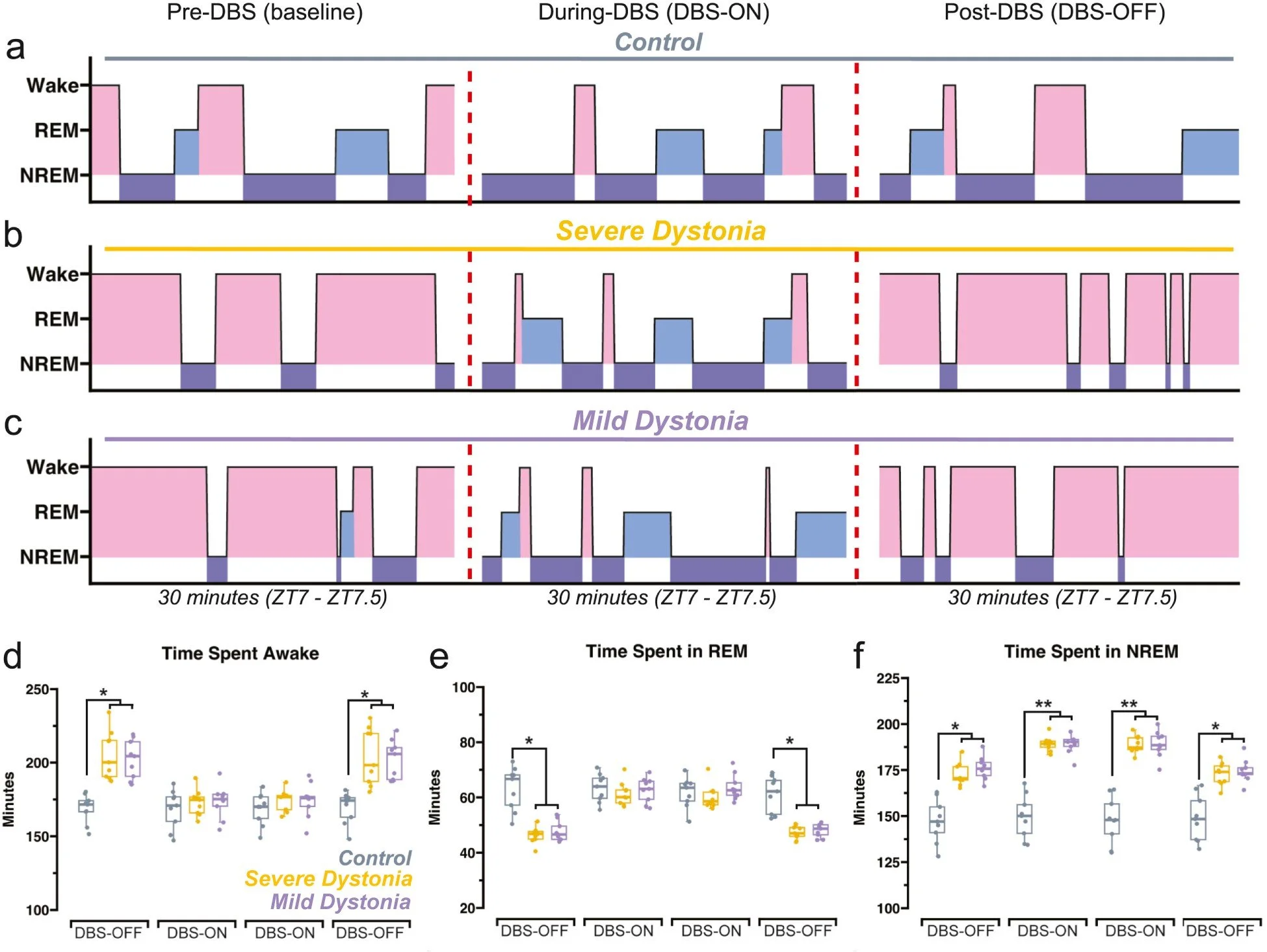
Cerebellar DBS normalizes time spent awake and in REM sleep in dystonic mice. a-c) Hypnograms showing sleep cycle structure in normal and dystonic mice before, during, and after cerebellar DBS. Notice that excessive wake time is reduced and absent REM sleep reappears in dystonic mice when DBS is applied. d-f) Quantification of amount of time spent awake, in REM sleep, and in NREM sleep in normal and dystonic mice before, during, and after cerebellar DBS. Notice that time awake and in REM sleep is normalized to control levels when DBS is applied. Adapted from Salazar Leon, L. E., Kim, L. H. & Sillitoe, R. V. Cerebellar deep brain stimulation as a dual-function therapeutic for restoring movement and sleep in dystonic mice. Neurotherapeutics 21, e00467 (2024).
The cerebellum is implicated in a growing list of cognitive functions, including language production. Injuries to different cerebellar structures can result in different symptoms, ranging from motor incoordination to mutism. Additionally, recovery prognosis varies based on lesion location. Do different subsets of cerebellar neurons contribute to separate motor and non-motor symptoms? To answer this question, we used intersectional genetics to silence specific cortical and subcortical populations of cerebellar neurons in developing mice. Silencing both populations resulted in severe motor dysfunction and developmental delay of ultrasonic vocalizations, inaudible squeaks produced by young mice to call for their mother. However, when only subcortical neurons were manipulated, movement deficits persisted while social vocalizations were preserved. Thus, separate populations of cerebellar neurons are essential for the proper development of motor and non-motor behaviors, and identifying these populations sets the stage for more precise and effective treatments.
Relevant References
Kim, L. H., Brandenburg, C. & Sillitoe, R. V. Cerebellar motor and non-motor contributions to dystonia pathophysiology and treatment. Dystonia 5, (2026).
Brandenburg, C., Srivastava, S., Hipolito, A. G. R., Lin, T., Arenkiel, B. R. & Sillitoe, R. V. Frequency-dependent cerebellar circuits independently gate social vocalizations and movement. bioRxiv (2026).
Salazar Leon, L. E., Kim, L. H. & Sillitoe, R. V. Cerebellar deep brain stimulation as a dual-function therapeutic for restoring movement and sleep in dystonic mice. Neurotherapeutics 21, e00467 (2024).
Salazar Leon, L. E., Brown, A. M., Kaku, H. & Sillitoe, R. V. Purkinje cell dysfunction causes disrupted sleep in ataxic mice. Dis. Model. Mech. 17, (2024).
Salazar Leon, L. E. & Sillitoe, R. V. Disrupted sleep in dystonia depends on cerebellar function but not motor symptoms in mice. Dyst. 2, (2023).
van der Heijden, M.E., Rey Hipolito, A.G., Kim, L.H. et al. Glutamatergic cerebellar neurons differentially contribute to the acquisition of motor and social behaviors. Nat Commun 14, 2771 (2023).
Salazar Leon, L. E. & Sillitoe, R. V. Potential interactions between cerebellar dysfunction and sleep disturbances in dystonia. Dystonia 1, (2022).