Technology Development - Therapeutics
Neuromodulation for the treatment of neurological disorders remains a promising and rapidly advancing field of study. While most studies and commercial inventions aim to restore motor or non-motor function by targeting structures like the motor cortex and basal ganglia, the cerebellum represents a greatly understudied brain area with few dedicated efforts at commercialization despite its emerging importance as a major contributor to various motor and non-motor disorders. Thus, cerebellar neuromodulation remains a largely untapped research opportunity for technology development and commercialization which may be utilized as a platform for therapeutically targeting many different types of disease with motor and non-motor symptoms.
With our lab’s decades of robust cerebellar studies and pioneering research into the therapeutic potential of cerebellar deep brain stimulation, the Sillitoe lab regularly generates powerful and novel insights into the neural circuits and mechanisms underlying many diseases spanning traditional cerebellar-related disorders like ataxia, tremor, and dystonia and other cognitive deficits like sleep, speech, and social behavior. With our unique position at the intersection of cutting-edge translational research and commercialization, we aim to develop exciting new research and inventions that push our understanding of the cerebellum in health and disease while providing tangible products and methods to serve the community of patients suffering from cerebellar-related disorders. To facilitate this mission, we actively collaborate with the BCM Innovation Institute, Cerebellum Science Center, Torpedo Therapeutics, and other partners in industry and academia. If you share our mission to empower patients through innovative research in the cerebellum, we welcome prospective graduate students, partners in industry or academia, and generous donors to learn more about our work by reaching out to us.
Current technologies we are actively developing in the lab include various methods of cerebellar neuromodulation for the treatment of neurological disorders including closed-loop deep brain stimulation (DBS), electrophysiological and other biomarkers of disease, and the cell type-specific therapeutic modulation of unconventional cerebellar circuits. To do this, we leverage our discoveries of novel cerebellar circuits and mechanisms with our expertise in DBS, electrophysiology, optogenetics, intersectional genetics, pharmacological manipulations, anatomy, animal models, and motor and non-motor behavioral assays. Our strategic partnerships with clinical experts in the Texas Medical Center and the BCM Innovation Institute establish a rigorous pipeline of translation and innovation that could only be found at the largest medical center in the world.
The latest innovation from our lab, related to cerebellar closed-loop neurostimulation using biomarkers, is currently available for licensing or development/commercial partners. For more information, reference the following link: bcm.portals.in-part.com/4b554392-9c55-469d-904b-97290b28a1d9?utm_source=technologies&utm_medium=portal&utm_term=latest. Additional technologies are currently under development.
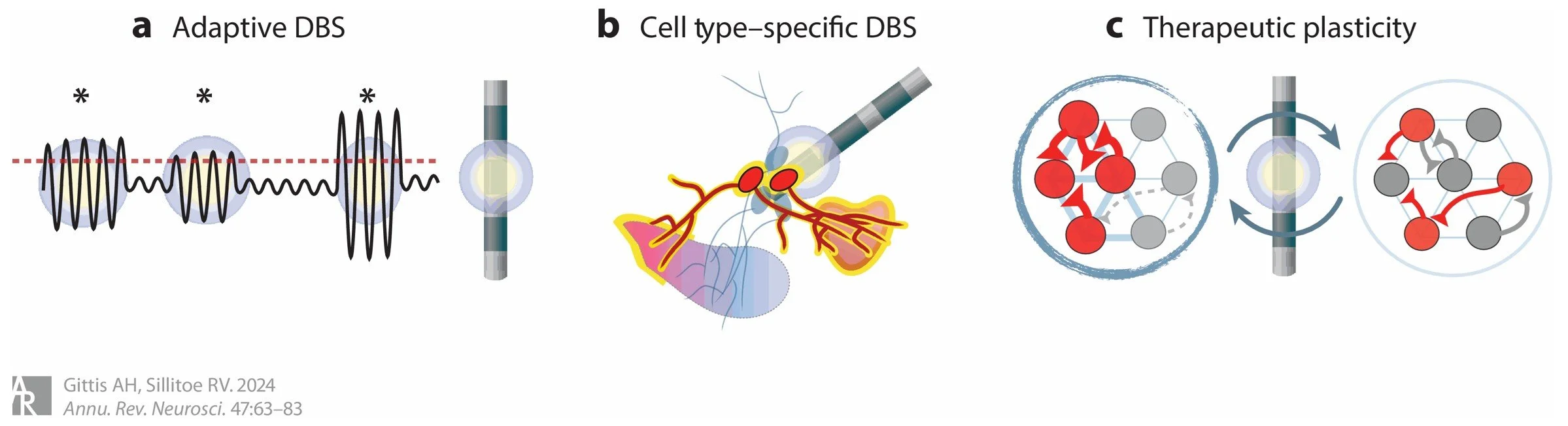
Figure Legend: Summary of recent innovations to stimulus parameters for deep brain stimulation (DBS). (a) Adaptive DBS refers to a stimulation paradigm in which feedback from the brain is used to control stimulus delivery through closed-loop stimulation. Leading candidates for biological feedback signals to trigger adaptive DBS are pathological oscillations: 10–30-Hz range for Parkinson's disease or 4–12-Hz range for dystonia. (b) Cell type–specific DBS seeks to leverage differences in axon excitability, cell morphology, or synaptic connectivity to bias effects of stimulation toward specific neural pathways. (c) Varying the timing or pattern of DBS stimulation can induce therapeutic plasticity in networks to induce long-lasting behavioral effects. In coordinated-reset DBS, bursts of stimulation were delivered to different sites across the STN to train the network out of its pathologically synchronous state, resulting in long-lasting attenuation of parkinsonian motor symptoms. Alternatively, linking stimulus delivery to ongoing behavior has shown promise for reinforcing healthy patterns of network activity and diminishing pathological activity.